Mesh Area Lights
Sampling Strategies for Monte Carlo Path Tracing
Project Overview
This research investigates the efficiency of different sampling strategies for mesh area lights in Monte Carlo path tracing, with a focus on hierarchical and visibility-aware techniques. The study employs a custom CPU ray tracer (Prometheus) built with Intel Embree, comparing four sampling approaches across scenes of varying complexity.
Monte Carlo Integration
Physically-based rendering using stochastic sampling to approximate the rendering equation.
Hierarchical Sampling
Light BVH with flux-based importance for efficient sample distribution across mesh lights.
Visibility-Aware MIS
Learned visibility probabilities combined with Multiple Importance Sampling for optimal results.
Sampling Strategies
Four distinct sampling strategies were implemented, each representing a different point on the complexity-efficiency spectrum.
Uniform Sampling
Baseline random sampling with equal probability
Area-Importance
Solid angle weighted sampling
Hierarchical Flux
BVH-based importance traversal
Visibility-Aware MIS
Learned visibility with multiple importance sampling
Uniform Sampling
The simplest approach where each point on the light surface has equal probability of being selected. Triangle selection is performed proportionally to surface area using a precomputed cumulative distribution function (CDF).
p_A = 1 / AExperimental Results
Visual quality measured using Mean Squared Error (MSE) against ground truth images at 20,000 SPP. Performance measured as render time in seconds.
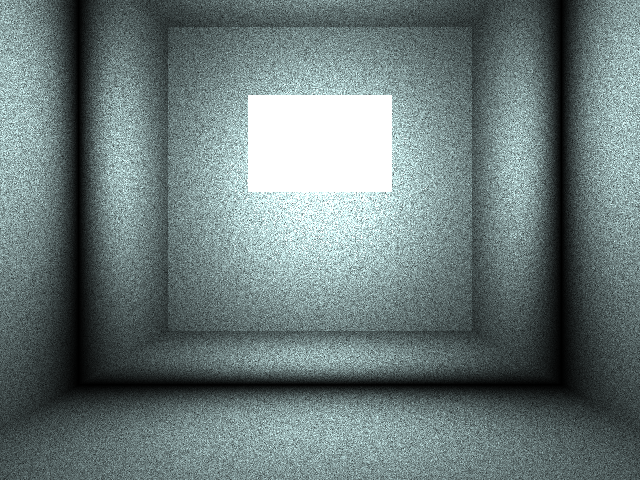
Ground Truth (20,000 SPP)
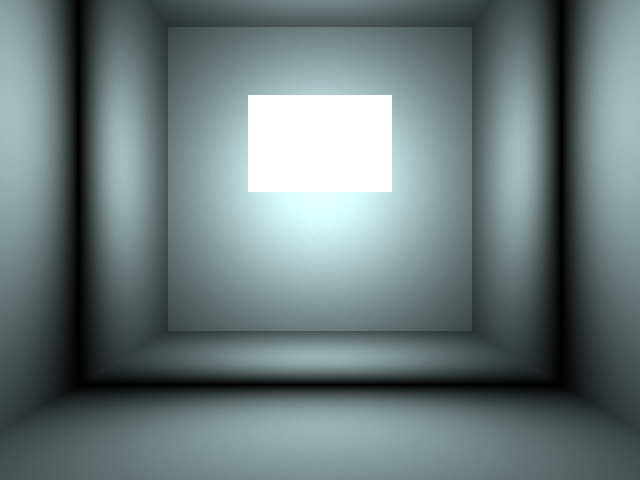
Baseline scenario with a single rectangular area light. All strategies converge identically, confirming implementation correctness.
Strategy Comparison at 32 SPP
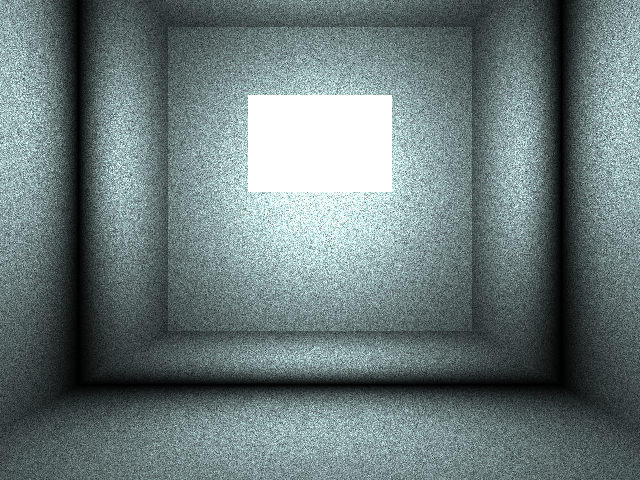
Uniform
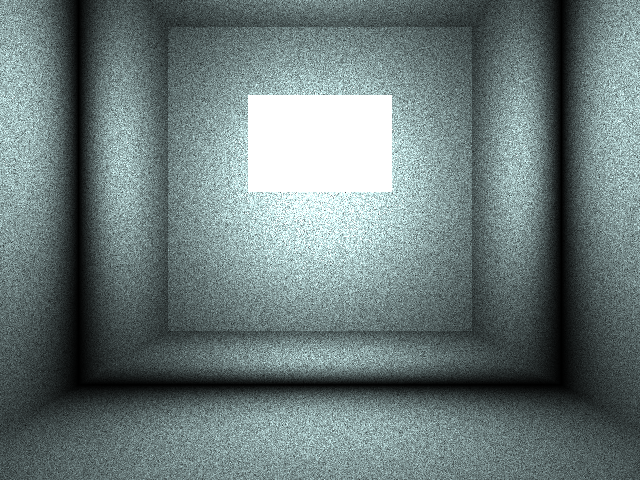
Area-Importance
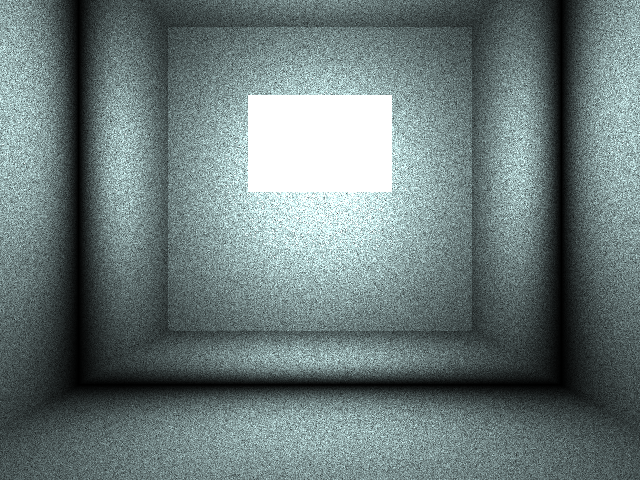
Hierarchical Flux
Visibility-Aware MIS
Detailed Results
| Strategy | 1 SPP MSE | 16 SPP MSE | 256 SPP MSE | 256 SPP Time |
|---|---|---|---|---|
| Uniform | 1.47E-01 | 1.92E-02 | 1.34E-03 | 0.611s |
| Area-Importance | 1.56E-01 | 1.69E-02 | 1.19E-03 | 2.905s |
| Hierarchical Flux | 1.52E-01 | 1.76E-02 | 1.24E-03 | 2.599s |
| Visibility-Aware MIS | 1.53E-01 | 1.76E-02 | 1.25E-03 | 4.074s |
Convergence Analysis
MSE vs. Samples per Pixel
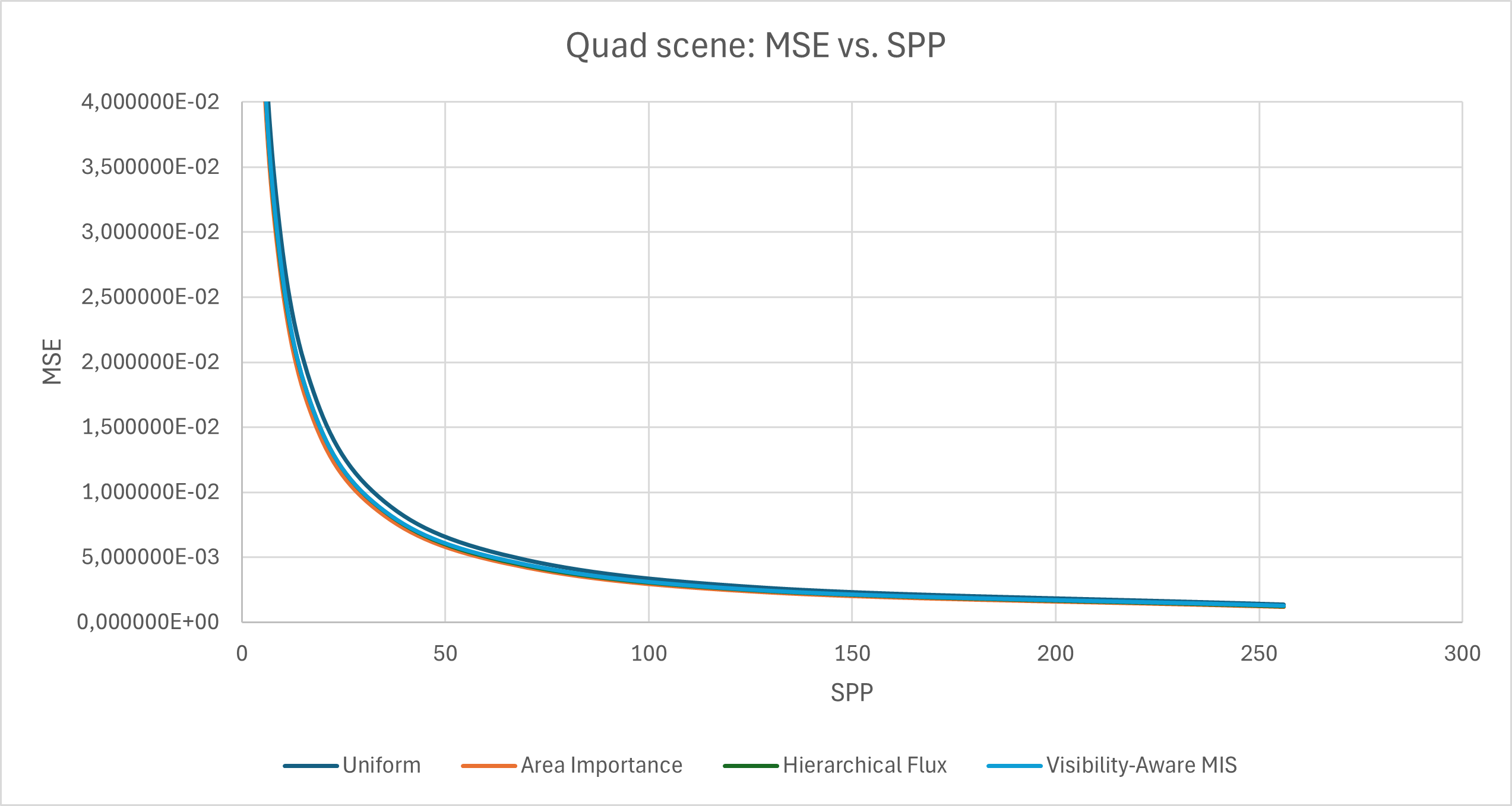
Lower MSE indicates better convergence to ground truth.
Render Time vs. Samples per Pixel
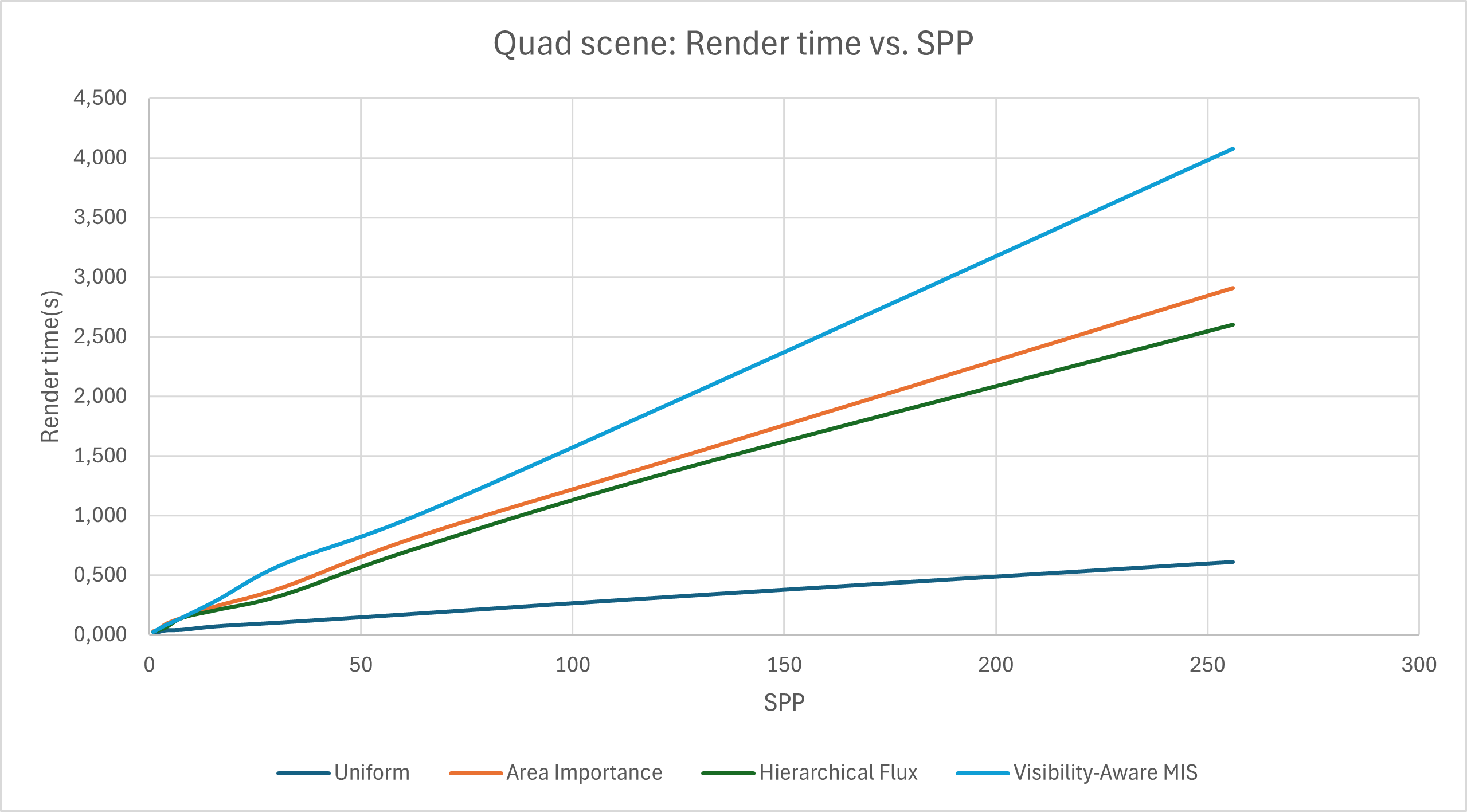
Hierarchical methods show overhead in simple scenes but scale better with complexity.
Key Findings
Hierarchical Flux Sampling
Provides the best overall trade-off between variance reduction and computational efficiency for mesh area lights.
Area-Importance Limitation
Despite theoretical advantages, O(n) solid angle computation makes it impractical for production use.
Visibility-Aware Benefits
Significant improvements in high-occlusion scenarios where geometric blocking wastes samples.
Scene Complexity Matters
Optimal strategy selection depends on scene characteristics—simple scenes favor low-overhead methods.
Technical Implementation
Intel Embree 4
High-performance ray tracing
Light BVH
SAOH-based tree construction
Importance Sampling
Flux-weighted traversal
Visibility Cache
Spatial hash grid learning
MIS Framework
Balance heuristic weighting
Statistical Validation
Mann-Whitney U tests
C++20
Modern parallel execution
The Journey
This project pushed me into territory I had never explored before—solid angles, spherical triangles, Monte Carlo integration, and probability density functions. These were not just abstract concepts to memorize, but tools I had to actually implement and debug in a working ray tracer.
Technical Challenges Overcome
- Implementing van Oosterom and Strackee's solid angle formula with numerical stability
- Building a Light BVH with Surface Area Orientation Heuristic (SAOH)
- Debugging Monte Carlo estimators where errors produce black screens or noise
- Integrating visibility learning with stochastic tree traversal
- Computing PDFs for MIS by reconstructing tree traversal paths
This research confirmed that graphics programming is what I want to pursue further. The combination of mathematics, programming, and visual results is exactly what I find most engaging in computer science.